

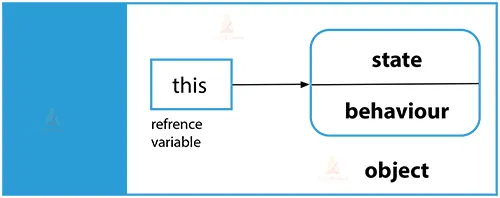
In Java programming, the “this” keyword refers to the current instance of the class in which it is used. It is essentially a reference to the object on which a method was invoked or the object for which a constructor is being executed. The primary purpose of the “this” keyword is to avoid ambiguity when dealing with class variables and instance variables that share the same name.
this keyword
The “this” keyword in Java is a reference that points to the current instance of the class in which it is used. It is primarily used within non-static methods and constructors to distinguish between instance variables and local variables that might share the same name. The “this” keyword helps in accessing and manipulating the members of the current object, making code more clear and unambiguous. Additionally, it can be used for constructor chaining and method chaining.
Usage of this keyword:
Accessing Instance Members:
- Used to differentiate between instance variables and local variables within a method.
- Enables manipulation and access of instance variables within the current object.
Constructor Chaining:
- Allows one constructor in a class to call another constructor within the same class.
- Useful when different constructors need to perform common initialization tasks.
Returning Current Object:
- Used to return the current object from a method, enabling method chaining.
- Allows multiple method calls on the same object in a single line.
Passing Current Object to Methods:
- Passes the current object as an argument to other methods, enabling them to operate on the object’s data.
Passing “this” to Inner Classes:
- Within inner classes, “this” refers to the inner class instance.
- To reference the outer class instance, use “OuterClassName.this”.
Referring to Outer Class in Nested Class:
- When a nested class (non-static inner class) has the same variable name as an outer class member, “this” can be used to access the outer class instance.
Avoiding Ambiguity:
- Helps clarify code by specifying that an instance variable is being accessed, avoiding confusion with local variables.
Setting Instance Variables:
- Used to set the values of instance variables from within a method or constructor.
Method Parameter Distinguishing:
- When a method parameter shares a name with an instance variable, “this” can distinguish between them.
Reference to Current Object:
- “this” acts as a reference to the current object instance on which the method is invoked.
Enabling Object-Oriented Communication:
- Facilitates interaction between methods and properties of the current object.
Example:
1. Accessing instance variables:
public class student {
    private int value;
    public void setValue(int value) {
        this.value = value; // Using 'this' keyword to refer to the instance variable, and 'value' to refer to the method parameter.
}
public void getValue()
{
return this.value
    }
public static void main(String args[]) {
student obj = new student();
Obj.setValue(10);
System.out.println(obj.getValue());
}
Output:
10
In this case, when you create an instance of a student and call the setValue method, it will set the instance variable value to the value passed as the argument.
2. Constructor chaining:
public class student {
    private int x;
    private int y;
    public student(int x) {
        this(x, 0);      // Calls the constructor with two parameters using 'this'.
    }

    public TechVidvan(int x, int y) {
        this.x = x;
        this.y = y;
    }
    public static void main(String[] args) {
        student obj1 = new student(5);
        System.out.println(" x = " + obj1.x + ", y = " + obj1.y);
        student obj2 = new student(10, 20);
        System.out.println(" x = " + obj2.x + ", y = " + obj2.y);
    }
}
Output:
x=5,y=0
x=10,y=20
When you create an instance of a student using the constructor student(int x), it will call the second constructor student(int x, int y) with y initialized to 0.
3. Returning the current object from a method (method chaining):
public class TechVidvan {
    private int value;
    public TechVidvan setValue(int value) {
        this.value = value;
        return this;       // Returns the current object to enable method chaining.
}
    public static void main(String[] args) {
        TechVidvan obj = new TechVidvan();
        obj.setValue(42).setValue(99); // Method chaining
        System.out.println("Value:  " + obj.value);
    }
}
Output
Value: 99
In this scenario, when the setValue method is utilized, it assigns a value to the instance variable “value” and subsequently gives back the current object. This enables you to link numerous method calls consecutively.
4. Passing the current object to other methods:
public class student {
    private int value;
    public void TechVidvan() {
        learn(this);
    }
    private void learn(student obj) {
System.out.println(“This calls the method learn”);
    }
public static void main(String args[])
{
student Obj = new student();
        Obj.TechVidvan();
}
Output:
This is called the method of learn
The current object is sent as a parameter to the TechVidvan function when the learn method is called. You have the option to do actions on the received object inside the TechVidvan function.
Using “this” in Constructor Overloading:
Example Code:
class Student {
    private String name;
    private int age;

    public Student(String name) {
        this.name = name;
    }

    public Student(String name, int age) {
        this(name); // Call the single-parameter constructor
        this.age = age;
    }

    public void printDetails() {
        System.out.println("Name: " + name + ", Age: " + age);
    }

    public static void main(String[] args) {
        Student student1 = new Student("Alice");
        student1.printDetails(); // Output: Name: Alice, Age: 0

        Student student2 = new Student("Bob", 20);
        student2.printDetails(); // Output: Name: Bob, Age: 20
    }
}
Output:
Name: Alice, Age: 0
Name: Bob, Age: 20
The key takeaways regarding the “this” keyword are:
Code Clarity: The “this” keyword enhances code readability by making it clear when instance variables are being accessed or manipulated.
Instance Member Access: It facilitates easy access to instance variables and methods within the current object.
Constructor Chaining: “this” simplifies constructor chaining, enabling one constructor to reuse the logic of another constructor within the same class.
Method Chaining: It enables method chaining by allowing methods to return the current object, allowing for consecutive method calls.
Passing as Argument: “this” can be passed as an argument to methods or other constructors, enabling them to work with the current object’s data.
Avoiding Ambiguity: It helps prevent confusion between local variables and instance variables that share the same name.
Disadvantages of Using the “this” Keyword:
Redundancy and Clutter:
- Overuse of the “this” keyword might lead to code that appears cluttered and unnecessarily verbose.
Readability Issues:
- If used excessively, the code can become harder to read and understand, defeating the purpose of code clarity.
Unintentional Confusion:
- Misusing the “this” keyword can cause unintended behaviour, especially in cases where it’s not needed.
Conclusion
The “this” keyword in Java serves as a reference to the current instance of a class. It plays a significant role in enhancing code clarity, managing object instances, and simplifying interactions within object-oriented programming. By allowing developers to distinguish between instance variables and local variables, it helps avoid ambiguity and naming conflicts.