Success Stories – They Believed, Learned & Achieved!













Need Personalized Guidance? Talk Directly to Your Instructor

Numbers That Speak Our Success
Our learners are working in leading organizations
Learn From Industry’s Best Instructors


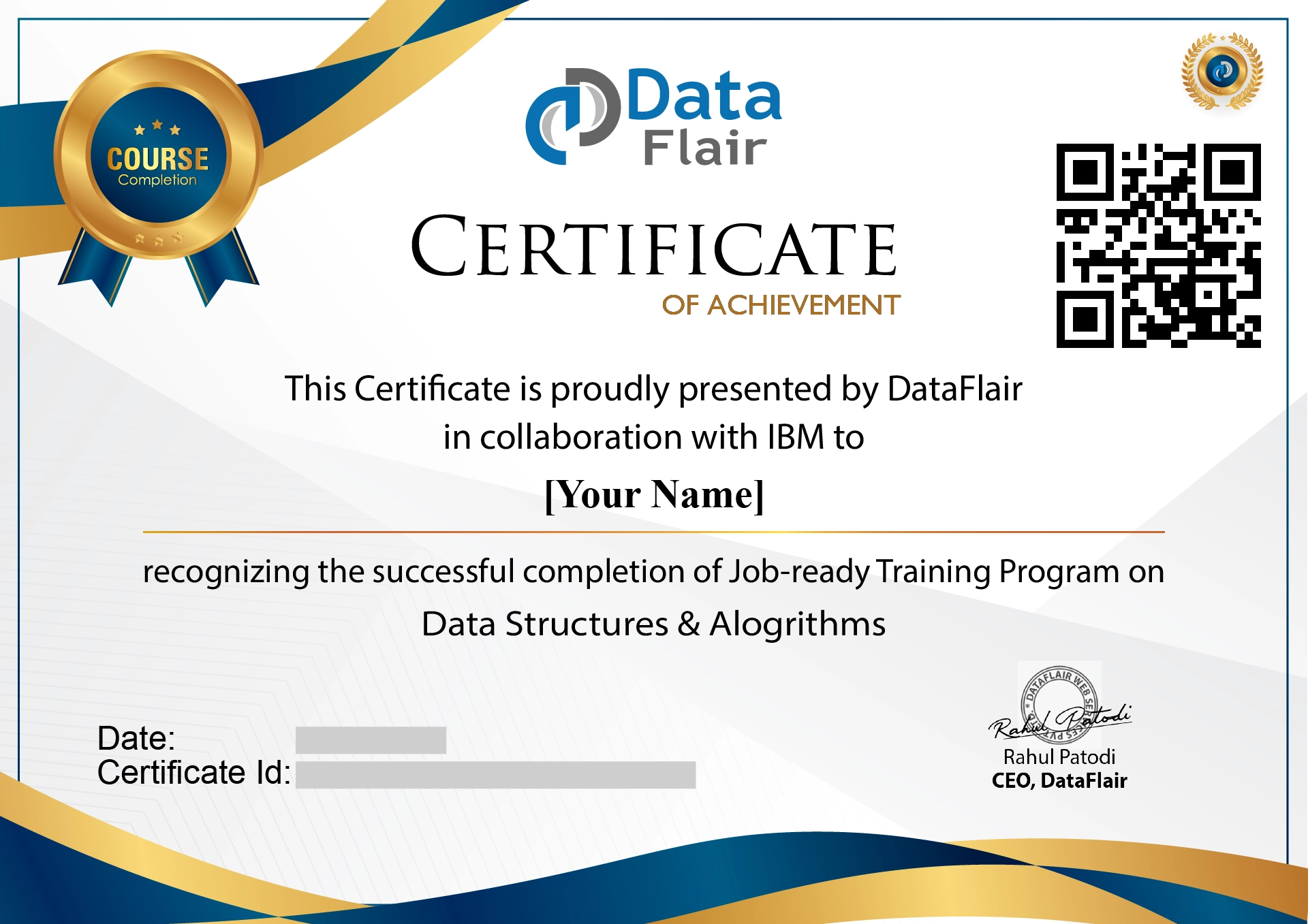
Gain industry-ready skills and earn an official certificate from DataFlair and IBM.











Looking for Industry Expert Counselling?
We are a team of trainers who have 20+ years of Industry Experience. They provide project based training and cover real time scenarios during the interactive training sessions.
Contact our Industry Experts & get answers to all your queries.
About Data Structures
Courses on data structures provide an introduction to the fundamentals of managing, organizing, and storing data effectively for maximum access and change. For aspiring computer scientists, software engineers, and anybody else interested in the principles of data processing, these courses are essential. Through an in-depth exploration of many data structures, including arrays, linked lists, stacks, queues, trees, and graphs, students acquire the capacity to evaluate and execute solutions that are both scalable and efficient.
Furthermore, the importance of algorithmic thinking is frequently covered in these courses, allowing students to approach problems methodically and assess how well various data structures perform for certain applications. Students can gain real expertise in developing and optimizing data structures in one or more programming languages, such as C, C++, Java, or Python, in addition to theoretical understanding through practical sessions in data structure courses.
Applying the ideas to real-world problems—from straightforward data management concerns to intricate computational challenges—helps to reinforce the principles. Data structure classes, a mainstay of computer science education, provide a strong foundation of fundamental concepts and methods that prepare students for further coursework and jobs in software development, data analysis, and related fields.
How Is TechVidvan different from others?
TechVidvan sets itself apart from other resources and platforms for education in a number of important areas, especially when it comes to offering courses on technology and data science. The following premium attributes demonstrate how TechVidvan is unique-
- Extensive Study Resources
TechVidvan offers students a vast array of study resources, such as case studies, notes, tests, and video lectures, enhancing and diversifying the learning process. These materials are made to accommodate various learning preferences and make sure students have all they need to comprehend and become experts in the subject matter.
- Interactive Tests and Assessments
To assist students in determining how well they have understood and retained the course information, the platform includes interactive tests and assessments. These tests give quick feedback, enabling students to see where they still need to improve and monitor their development over time.
- Placement-ready Courses
TechVidvan clearly focuses on preparing students for placements in its courses. This indicates that the curriculum closely matches the information and abilities that employers value. TechVidvan makes sure that its students are equipped to meet the expectations of the labor market after completing their courses by emphasizing industry requirements and the newest technical advancements.
- Live Projects & Practicals
TechVidvan emphasizes experiential learning heavily through the use of live projects and practical exercises that mimic real-world situations. This method makes sure that students may put their theoretical knowledge to use in real-world scenarios, which helps them develop important abilities that employers value.
- Job Updates & Career guidance
TechVidvan offers its learners more than simply instructional content; in addition, it offers job updates and career guidance services. This greatly improves the job search process for learners and includes résumé creation, interview preparation, and access to a network of potential employers.
- Opportunities for Internships
A number of TechVidvan courses provide internships, enabling students to obtain real-world work experience prior to finishing their studies. These internships can be quite helpful as stepping stones because they give vital experience and frequently result in employment offers.
- Live Session with the Trainer
TechVidvan provides live sessions with trainers, in contrast to many other online platforms that make extensive use of pre-recorded content. Through these sessions, students can get answers to their questions, have their concerns cleared up, and participate in conversations in real time, which enhances and personalizes the learning process.
- Expert-Led Instruction
TechVidvan courses are taught by professionals with extensive practical expertise in their disciplines, in addition to their academic qualifications. Because of this synthesis of scholarly information and real-world experience, students gain knowledge and skills that they may use immediately in the workplace, improving their employability.
Why should you learn Data Structures Courses from TechVidvan?
Gaining understanding of Data Structures from TechVidvan places you in a unique position within the technological education environment, where theoretical concepts are applied practically-
- This platform gives you the knowledge and practical skills required for today’s fast-paced, problem-solving contexts while acknowledging the fundamental significance of data structures in practically every computing endeavor. The breadth and depth of data structures are covered in detail in TechVidvan’s curriculum, which ranges from simple ideas like stacks and queues to more intricate structures like trees and graphs. In order to make sure you are learning how to solve difficulties in the present as well as being ready for challenges in the future, the courses are updated frequently to reflect the most recent developments in technology and industry demands.
- TechVidvan stands out for its pragmatic, hands-on approach. Through the integration of real-world projects and practicals into the educational process, students are able to apply theoretical knowledge to real-world situations right away. This approach to learning by doing improves comprehension, memory, and the capacity to come up with original ideas in a setting similar to the workplace. These hands-on learning opportunities are priceless because they offer perspectives on troubleshooting and debugging that are sometimes absent from more conventional, lecture-based learning settings. Additionally, the projects you work on might serve as important focal points in your professional portfolio, demonstrating to prospective employers your range of abilities.
- Beyond just the technical abilities, TechVidvan’s extensive ecosystem promotes your whole professional growth. With expert-led training, you receive outside-the-classroom guidance and insights from experts who have successfully overcome the problems you’re learning to tackle. You may determine your progress and areas for growth with the use of interactive exams and evaluations, which guarantee a customized learning experience. Additionally, a clear route to employment is provided by TechVidvan’s dedication to preparing you for the workforce with career guidance, job updates, and internship possibilities. TechVidvan is a great option for people who want to become experts in data structures and start or grow their careers in technology because of its all-encompassing approach, which prepares you both professionally and technically.
Training Benefits
In order to meet the needs of the contemporary technology sector, TechVidvan offers a comprehensive training program that combines the theoretical knowledge and practical skills necessary for success in the field. The focus TechVidvan places on experiential learning via real-world applications and actual projects is one of the training’s main advantages. This method not only strengthens comprehension but also sharpens problem-solving skills, enabling students to handle challenging situations that they could face in the workplace.
Additionally, TechVidvan guarantees that students have access to the newest tools and techniques, providing them a competitive edge in the job market, thanks to its dedication to being up to date with industry trends. TechVidvan’s training program not only develops practical skills but also provides access to knowledgeable professors that infuse the classroom with their industry experience.
Through their advice, insight, and mentoring, students receive important perspectives that go beyond what they would learn in a textbook. In addition to extensive study guides and interactive tests, TechVidvan’s training guarantees that students have a well-rounded education that equips them for success in the quickly developing technology industry. To give you a gist, following are the major training benefits-
- TechVidvan places a strong emphasis on hands-on learning, giving students the opportunity to gain practical skills via case studies and real-world projects. With this technique, students are certain to grasp academic ideas and acquire real-world experience that will benefit their future professions.
- Industry professionals with years of real-world experience instruct TechVidvan courses. Students profit from these teachers’ experience and wisdom, acquiring knowledge and guidance that can hasten their academic progress and professional development.
- TechVidvan provides an extensive curriculum that covers a variety of data science and technology subjects. Students can choose from a wide range of learning tools that support their own interests and professional objectives, including anything from basic concepts to sophisticated procedures.
- With TechVidvan’s flexible learning options, students may learn at their own pace and on their own schedule. These options include self-paced courses and live instructor-led sessions. Because of this flexibility, students can adjust their learning to meet their individual needs and mix their academics with other responsibilities.
- TechVidvan provides career development support services, such as help with job placement, interview preparation, and resume building. TechVidvan guarantees that learners are not only prepared with technical skills but also for professional success by offering advice and resources to assist them achieve in their jobs.
Job Roles
Since data structures are the foundation of effective data management and manipulation, an understanding of them is essential to both computer science and software engineering. The essential components for efficiently accessing, retrieving, and modifying data are provided by data structures, which help organize and store data. People can examine problems and create algorithms that are optimized for different computer tasks by learning data structures.
Data structure expertise is necessary for creating reliable and scalable solutions, whether managing massive datasets, putting search and sort algorithms into practice, or creating intricate software systems. Furthermore, the performance and efficiency of software applications are greatly improved by data structures. Developers can greatly increase their program’s performance and resource efficiency by selecting the right data structure for a given task or problem.
By being aware of the trade-offs between various data structures and the algorithms that go along with them, developers may optimize their code for scalability, space complexity, and time complexity in an informed manner. To put it briefly, becoming knowledgeable about data structures helps people create software that is more dependable and efficient while also providing them with the tools they need to tackle computational challenges. After learning Data Structures, one can go for amazing job options such as-
- Software Engineer/Developer
A software engineer or developer is someone who designs, develops, and maintains software programs. They do this by using data structures. With data structures, they may optimize code performance and improve user experience whether they work on front-end interfaces, back-end systems, or full-stack development.
- Data Scientist
Large datasets are analyzed by data scientists in order to glean important patterns and insights that inform business choices. To analyze and manipulate data effectively, data scientists need to be proficient in data structures. This allows them to perform in-depth analysis and create prediction models.
- Database Administrator
Database administrators are in charge of overseeing and preserving databases. Optimizing query performance, building database schemas, and putting data storage options into practice all require an understanding of data structures.
- Systems Analyst
Systems analysts evaluate the information technology requirements of businesses and create plans to meet those needs. Systems analysts that comprehend data structures can create effective methods for storing and retrieving data that satisfy organizational needs.
- Algorithm Engineer
An algorithm engineer creates and refines algorithms to effectively tackle challenging computational issues. To create algorithms that efficiently handle data and increase performance and scalability, one must be proficient in data structures.
- Machine Learning Engineer
The creation of models and algorithms by machine learning experts enables computers to learn from and anticipate outcomes based on data. To process and arrange datasets such that machine learning algorithms may run effectively and produce accurate results, one must have a solid understanding of data structures.
- Cybersecurity Analyst
By spotting weaknesses and putting security measures in place, cybersecurity analysts guard the information networks of enterprises from online threats. To identify and reduce any security concerns, it is essential to analyze and correlate security data, which requires an understanding of data structures.
- Game Developer
For a variety of platforms, game developers craft immersive and interactive gaming experiences. When it comes to organizing game assets, integrating collision detection, and optimizing game performance for fluid gameplay, data structures are vital to the game development process.
- Network Engineer
Local area networks (LANs), wide area networks (WANs), and cloud infrastructure are all designed and managed by network engineers. Network traffic management, resource allocation, and optimization are all accomplished through the usage of data structures.
- Bioinformatics Analyst
Protein structure prediction and genome sequencing are two examples of the computer methods that bioinformatics analysts use to analyze biological data. To handle and analyze big biological datasets, find genetic patterns, and gain new insights into biological systems, one must have a solid understanding of data structures.
FAQs
To make data in a computer more useful, data structures are techniques to store and organize information. They serve as the basis for creating effective algorithms and resolving challenging issues, which makes them crucial to computer science.
The two basic forms of data structures are nonlinear and linear. Sequentially stored elements are kept in arrays, linked lists, stacks, and queues, which are examples of linear data structures. More intricate interactions between items are possible with nonlinear data structures like trees and graphs.
The effectiveness and performance of software programs can be greatly impacted by the data structure selection. More scalability, less memory consumption, and quicker execution times can all be achieved by using the right data structure.
Inserting (adding elements), deleting (removing elements), traversing (visiting each element), searching (finding specific elements), accessing (retrieving elements), sorting (arranging elements), merging (combining structures), and updating (modifying elements) are common operations on data structures.
Algorithms are a set of sequential steps used to solve issues or carry out tasks using data, whereas data structures concentrate on organizing and storing data. Algorithms function on the basis of data structures.
The nature of the issue, the kinds of operations that must be carried out on the data, the anticipated size of the dataset, and the application’s efficiency needs are important factors to take into account.
Whereas space complexity relates to the quantity of memory used, time complexity is the length of time it takes to complete an action. Performance may be impacted by the time and space difficulties of various data types and processes.
By providing guidelines for data storage, access, and modification, data structures give programmers a means to organize and work with data in a structured manner.
Which practical uses for data structures exist in the field of software development?
Databases, file systems, network protocols, compilers, and several more real-world applications are examples of systems where effective data processing and organization are crucial.
Best practices include selecting the appropriate data structure for the task at hand, putting effective algorithms for frequently used operations into practice, and taking scalability and memory consumption into account.
A number of professions are available for employment, such as those in game development, cybersecurity, algorithmic design, machine learning, database administration, systems analysis, and software engineering. Within the tech sector, proficiency with data structures is highly regarded by a variety of businesses.
Hash tables, priority queues, trie structures, and B-trees are examples of advanced data structures. In applications like databases, networking protocols, and search algorithms that call for effective data storage, retrieval, and manipulation, they are utilized.
Proficiency in data structures and algorithms is essential for effectively addressing intricate problems in competitive programming, especially when time is of the essence. Participants who possess a thorough understanding of data structures are able to select the best course of action for each challenge and optimize their solutions in terms of speed and memory utilization.
Typical errors include selecting the incorrect data structure for the task, implementing operations in an inefficient manner, managing errors inadequately, and conducting insufficient testing. To avoid such errors, it’s critical to properly comprehend the features and constraints of each data structure and to carefully prepare and test your implementations.